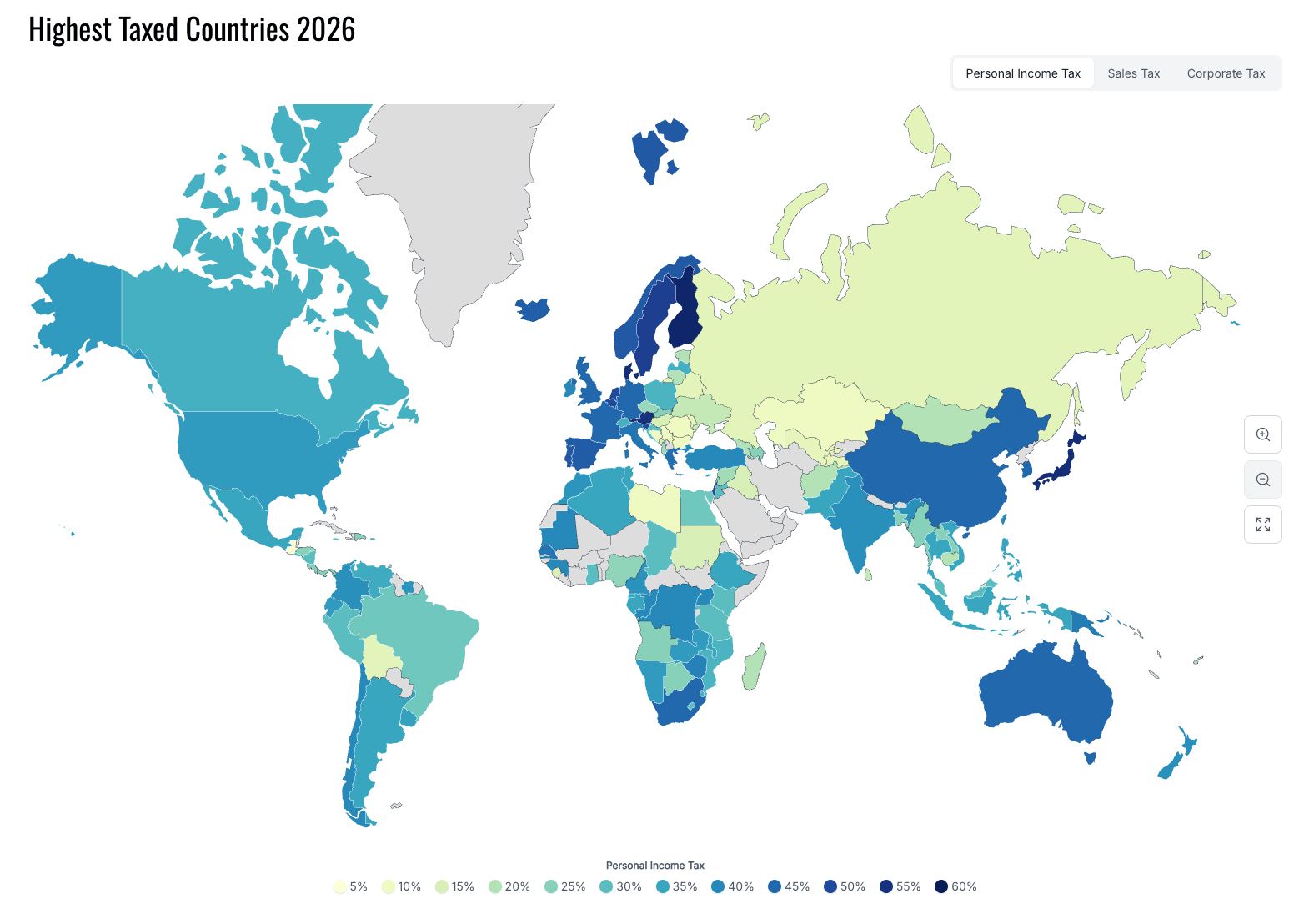
Question of the Day: Order these countries from highest to lowest tax rates - United States, Germany, Mexico
Tax season just came to a close! Check out how the US income tax rate stacks up...
Answer: Germany (45%), United States (37%), Mexico (35%)
Questions:
- Why do you think that taxes vary so much between countries?
- What are other ways a country can collect taxes other than income tax?
- Which country do you think provides the most benefits and services for its citizens? Explain.
Here are the ready-to-go slides for this Question of the Day that you can use in your classroom.
Behind the numbers (World Population Review):
"As the old adage goes, only two things in life are certain: death and taxes. Taxes can be a financial burden, but paying taxes is important for several reasons. Taxes are used to fund all manner of publicly-funded services including the military, public education, infrastructure such as roads and parks, police and fire departments, and public retirement and health programs such as Social Security and Medicare in the United States. Simply put, taxes provide the funds that a country needs to survive.
Taxes come in many forms, including sales tax, income tax, property tax, inheritance and estate taxes, excise tax, and more. Tax rates and regulations also vary greatly from country to country, and even within different parts of the same country. For example, most U.S. states charge some form of income tax, but an individual state’s income tax rate may be anywhere from 1% to 13.3%. Moreover, seven states (Alaska, Florida, Nevada, South Dakota, Texas, Washington, and Wyoming) do not collect any state income tax at all, and two more (New Hampshire and Tennessee) tax interest and dividend income, but not wages or salaries.
Similarly, most U.S. states charge a state sales tax, but some do not. However, states without a sales tax or an income tax may add or raise other taxes to make up for the deficit, such as implementing higher property tax rates. Finally, most governments that levy taxes charge different percentages based upon the amount of income or type of goods being taxed. For example, a person who makes $40k a year may pay 12% in income taxes while their next-door neighbor, who makes $200k, pays 25% or more. Similarly, sales of basic needs such as groceries are typically taxed at a much lower rate than sales of luxury items such as tobacco products or a new car. In this article, we’ll explore countries in terms of three main types of taxes: personal income tax, corporate tax, and sales tax."
About the Author
Kathryn Dawson
Kathryn (she/her) is excited to join the NGPF team after 9 years of experience in education as a mentor, tutor, and special education teacher. She is a graduate of Cornell University with a degree in policy analysis and management and has a master's degree in education from Brooklyn College. Kathryn is looking forward to bringing her passion for accessibility and educational justice into curriculum design at NGPF. During her free time, Kathryn loves embarking on cooking projects, walking around her Seattle neighborhood with her dog, or lounging in a hammock with a book.
SEARCH FOR CONTENT

Subscribe to the blog
Join the more than 11,000 teachers who get the NGPF daily blog delivered to their inbox:
MOST POPULAR POSTS